If you’re staring at an old cement sheet, a corrugated roof, or a cracked floor tile and wondering whether it’s asbestos, you’re asking exactly the right question, but there’s an important limit to what looking alone can tell you. Before booking an Asbestos Inspection Sydney homeowners rely on, it helps to know what asbestos-containing materials typically look like, so you can recognise the warning signs and know when testing is worth arranging. What this guide can’t do, and no visual guide honestly can, is confirm asbestos from a photo or a glance. Here’s what to look for, and why appearance alone is never the final answer.
What Does Asbestos Look Like?
Asbestos doesn’t have one single appearance, because it was mixed into more than 3,000 different building products across Australia. Depending on the product, it can look like flat grey sheeting, a corrugated roof, a vinyl floor tile, a fluffy grey coating on a pipe, or a textured, swirled ceiling finish. This is precisely why identifying it by sight is so difficult, there’s no single colour, texture, or pattern that applies across every asbestos-containing material.
How Can You Tell If Something Is Asbestos?
You genuinely can’t, not with certainty, just by looking. NSW Government guidance is clear that asbestos-containing materials come in different forms, colours, and textures, and appearance alone cannot confirm whether a material actually contains asbestos. What you can do is assess probability, based largely on the age of the building, the type of material, and its condition, then arrange proper testing to confirm what you’re actually dealing with.
What Does Asbestos Look Like in a House?
Around a typical older home, suspect materials commonly show up as flat or corrugated cement sheeting on walls, eaves, and fences, vinyl floor tiles hidden under carpet, textured or “popcorn” style ceiling coatings, and fibrous or dusty-looking material around pipes and in ceiling cavities. If your home was built or renovated before the late 1980s, treating these material types as suspect until tested is the safest approach.
What Colour Is Asbestos?
There’s no single reliable colour. Asbestos cement products are often grey in their raw form, but were routinely painted, rendered, or left to weather over decades, producing everything from off-white and cream to brown, green-tinged, or chalky pale grey depending on sun exposure and age. Vinyl floor tiles containing asbestos have turned up in beige, brown, grey, green, and terracotta finishes. Colour alone never confirms or rules out asbestos, which is one of the more persistent myths people rely on when trying to self-identify it.
Does Asbestos Have a Certain Texture?
Texture varies significantly by product type, and this is genuinely one of the more useful visual clues, though still not a confirmation. Asbestos cement sheeting is typically hard, dense, and rigid, often with a distinctive dimpled “golf ball” pattern on the reverse side. Textured ceiling coatings often show a swirled or stippled finish. Loose-fill insulation appears as a fluffy, granular material, and pipe lagging often looks like a white or off-white fibrous wrap that can appear dusty or cracking with age.
Can You Identify Asbestos by Looking at It?
No, not with certainty, and this is worth repeating because it’s the single most important takeaway from any visual guide. No one, not a builder, not an experienced tradesperson, not even an environmental scientist, can confirm asbestos content by eye. The fibres themselves are microscopic. Confirmation requires a sample collected and analysed by a NATA-accredited laboratory using polarised light microscopy. Visual inspection can only ever raise or lower your suspicion, never settle it.
What Does Asbestos Sheeting Look Like?
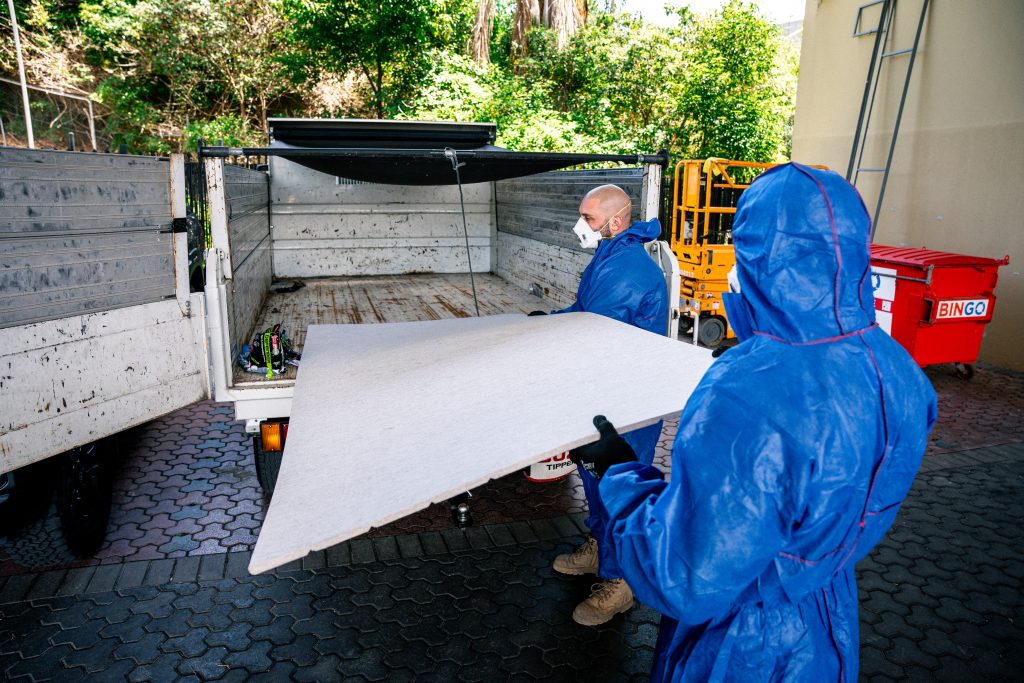
Asbestos cement sheeting, commonly called fibro, typically appears as flat or corrugated grey panels, though painted or weathered examples can look quite different. It’s a hard, solid material that doesn’t flex easily, and was widely used for internal and external walls, eaves, garages, and fencing. Modern, asbestos-free fibre cement sheeting can look virtually identical, which is exactly why age and testing matter more than appearance.
What Does Asbestos Cement Look Like?
Asbestos cement is the rigid, non-friable form found in most Australian homes, typically grey in its original state, dense, and unable to be crumbled by hand pressure when dry. It was used extensively in sheeting, roofing, guttering, downpipes, and even underground water and stormwater pipes. Its bonded nature means it generally presents low risk if left undisturbed and in good condition.
What Does Asbestos Roofing Look Like?
Older asbestos roofing typically appears as corrugated, moulded grey sheeting, often referred to by product names like “Super Six.” It’s a brittle material, and beyond the asbestos risk, poses a genuine fall-through hazard if walked on. Ridge capping on these roofs was also commonly made from the same asbestos cement material.
What Does Asbestos Insulation Look Like?
This varies depending on the specific product. Loose-fill roof insulation typically appears as a fluffy, grey or beige granular material, sometimes described as resembling candyfloss or fairy floss. Pipe lagging appears as a wrapped, often white or off-white fibrous covering, which can look dusty or be cracking with age. Sprayed limpet insulation, used on structural steel beams, has a low-density, fibrous appearance and is considered one of the highest-risk forms due to how easily it releases fibres.
What Do Asbestos Floor Tiles Look Like?
Vinyl floor tiles containing asbestos generally look no different from ordinary vinyl tiles of the same era, commonly appearing in beige, brown, grey, green, or patterned finishes, often found hidden beneath newer carpet or flooring. The backing and adhesive used to fix these tiles down can also contain asbestos, adding another layer that isn’t visible without lifting the flooring itself.
What Does Fibro Asbestos Look Like?
Fibro is simply the common name for asbestos cement sheeting, and it typically presents as flat, grey panels used for internal and external walls, particularly around wet areas like bathrooms and laundries. Asbestos Removal Sydney professionals frequently encounter fibro in older homes across the region, since it was one of the most widely used building materials in the decades before the asbestos ban, appearing in everything from garden sheds to full external cladding.
How Can I Identify Asbestos Without Touching It?
Look for the age of the property first, anything built or renovated before the late 1980s warrants caution. From there, visually note the location, condition, and general appearance of suspect materials without disturbing them, since undamaged, bonded asbestos poses minimal risk left alone. Photograph the material from a distance if it helps you describe it to a professional, but avoid touching, scraping, or attempting to break off a sample yourself, since disturbing suspect material is exactly what can release fibres into the air.
Can You Tell the Difference Between Asbestos and Fibro?
Not by looking, because fibro is simply a nickname for asbestos cement sheeting, not a separate material from it. The confusion arises because fibre cement sheeting is still manufactured today, using cellulose fibres instead of asbestos since the 2003 ban. Modern, asbestos-free fibro looks essentially identical to the older asbestos-containing version, so the only real distinguishing factor is the age of the material, not its appearance.
Does Old Cement Sheeting Contain Asbestos?
It’s genuinely likely if the sheeting predates the late 1980s to early 2000s, though not guaranteed. Age remains the strongest single predictor of asbestos content in Australian building materials, but the only way to know for certain is laboratory testing, since visually identical sheeting has been produced both with and without asbestos across different eras.
Get Certainty With Professional Testing
Spotting the warning signs is a genuinely useful first step, but it’s exactly that, a first step, not a final answer. If you’ve noticed any of the materials described here in your home, our licensed team can carry out proper testing to confirm what you’re dealing with and advise on the right next steps. Contact us today to arrange an inspection and get a clear, accurate answer.