If you’ve found suspected asbestos in your home and you’re weighing up whether to tackle it yourself or call in a professional, you’re not alone. It’s one of the most common questions Sydney homeowners ask before a renovation, and it’s a big part of why Sydney Asbestos Removal enquiries spike whenever a project uncovers old fibro or cement sheeting. The short answer is that limited DIY removal is legally permitted in NSW, but the rules are narrower and more conditional than a lot of online advice suggests. Before you pick up a crowbar, it’s worth understanding exactly what the law allows, what it requires of you, and when the smarter move is simply to call a licensed professional.
What Does NSW Law Actually Allow?
Under the Work Health and Safety Regulation 2017, an employer or self-employed person can carry out a limited amount of asbestos removal work without holding a licence, but only for non-friable (bonded) asbestos-containing material, and only where the total area does not exceed 10 square metres. This isn’t a blanket homeowner right to remove asbestos however you see fit. It comes with specific legal obligations attached, and it does not extend to friable asbestos under any circumstances.
The 10m² Rule Explained
The 10 square metre threshold refers to the total area of non-friable asbestos-containing material being removed, not the size of the room or project. If you’re removing bonded asbestos sheeting, this is roughly the size of a small bathroom’s worth of material. Go over that 10m² threshold, and the work legally must be carried out by a licensed asbestos removalist holding a Class B licence, or by someone who holds a bonded asbestos removal licence themselves. Importantly, staying under 10m² doesn’t mean the rules disappear. SafeWork NSW is explicit that before starting this kind of work, you must read and follow the Code of Practice for safely removing asbestos, understand and communicate the health risks to anyone involved, provide asbestos awareness training to any workers, and arrange health monitoring if the work is ongoing. If you’re not prepared to meet all of these obligations, SafeWork NSW’s own guidance is to engage a licensed asbestos professional instead.
Bonded vs Friable Asbestos: Why It Matters
This distinction is the single most important factor in what you’re legally allowed to do. Bonded (non-friable) asbestos has its fibres locked into a rigid material, such as cement sheeting, and doesn’t easily release fibres unless it’s cut, drilled, sanded, or broken. Friable asbestos is crumbly or has already been damaged to the point where it can be broken by hand pressure, meaning it releases fibres far more readily. Friable asbestos, including materials like sprayed limpet, asbestos cloth, millboard, and pipe lagging, must always be removed by a licensed professional holding a Class A licence, regardless of quantity. There is no DIY allowance for friable asbestos in NSW under any circumstances.
When Do You Need a Licensed Asbestos Removalist?
You need a licensed asbestos removal specialist if any of the following apply: the non-friable asbestos you’re removing exceeds 10 square metres in total, the material is friable in any amount, you’re not able or willing to meet the legal obligations around training, awareness, and health monitoring, or the work is being carried out as part of a business or workplace rather than genuine owner-occupier home maintenance. Given how easily these thresholds can be exceeded on a real renovation project, many Sydney homeowners find it’s simpler and safer to engage a licensed removalist from the outset. Worth noting too, if you do go down this path, licensed removalists are required to notify SafeWork NSW at least five days before licensed removal work begins, which is one of several formal obligations that don’t apply to genuine small-scale owner-occupier removal under the 10m² threshold.
What Are Class A and Class B Asbestos Licences?
A Class A licence permits the removal of any amount of friable asbestos, as well as bonded asbestos of any quantity. It’s the highest level of licensing and requires specialised training, equipment, and containment procedures. A Class B licence permits the removal of bonded (non-friable) asbestos only, generally for quantities exceeding the 10m² unlicensed threshold. Both licence types require formal training through a registered training organisation and are issued and regulated by SafeWork NSW.
Can You Remove Asbestos During a Home Renovation?
Potentially, but the same 10m² non-friable threshold and legal obligations still apply, and renovations often make it easy to underestimate the total area involved once walls, flooring, and ceiling materials are all factored in together. It’s also worth remembering that if a contractor carries out the removal on your behalf, the work is legally considered to be occurring at a workplace, and SafeWork NSW regulates that work accordingly, even inside a private home.
What If You Accidentally Disturb Asbestos?
Stop work immediately. Don’t sweep, vacuum, or attempt to clean up dust or debris, since this can spread fibres further. Wet down the area lightly if it’s safe to do so, leave the area, and seek advice from a licensed asbestos removal company or SafeWork NSW before continuing. Accidental disturbance is one of the most common ways people are exposed to asbestos fibres, so treating any suspected material with caution from the outset is the best prevention.
How Should Asbestos Waste Be Disposed Of?
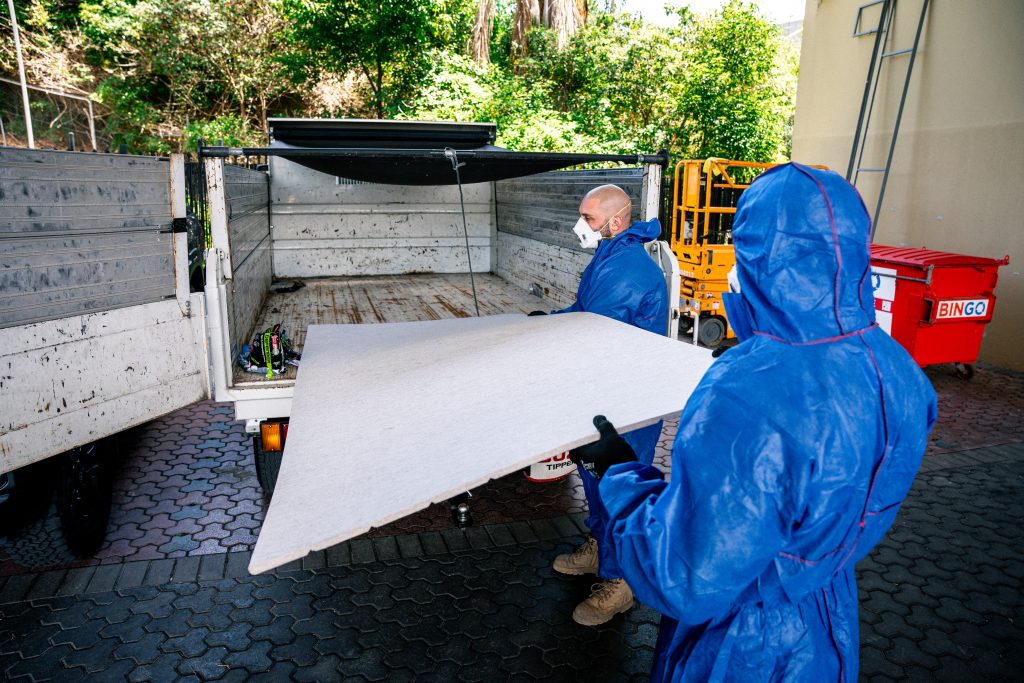
Asbestos waste must never go in household bins, skip bins, council clean-up collections, or be dumped by the roadside. It needs to be double-wrapped in heavy-duty plastic, clearly labelled, and taken to a facility licensed to accept asbestos waste. Many councils run dedicated asbestos disposal or collection programs, and for larger loads, a consignment must be tracked through the NSW EPA’s WasteLocate system.
Is DIY Asbestos Removal Really Worth the Risk?
For a genuinely small, contained job involving non-friable material well under the 10m² limit, and where you’re willing to meet every legal obligation involved, DIY removal is technically permitted. But asbestos-related diseases have no safe exposure threshold and often don’t appear for decades, and the margin for error in identifying, containing, and disposing of asbestos correctly is slim. For most Sydney homeowners, the peace of mind and compliance certainty of engaging a licensed asbestos removal specialist outweighs the cost saved by doing it yourself.
Get Professional Advice Before You Remove Asbestos
If you’re unsure whether your situation falls within the legal DIY threshold, or you’d simply rather leave it to the professionals, our licensed team can assess, test, and safely remove asbestos from your Sydney property. Contact us today for expert advice and a compliant, stress-free solution.